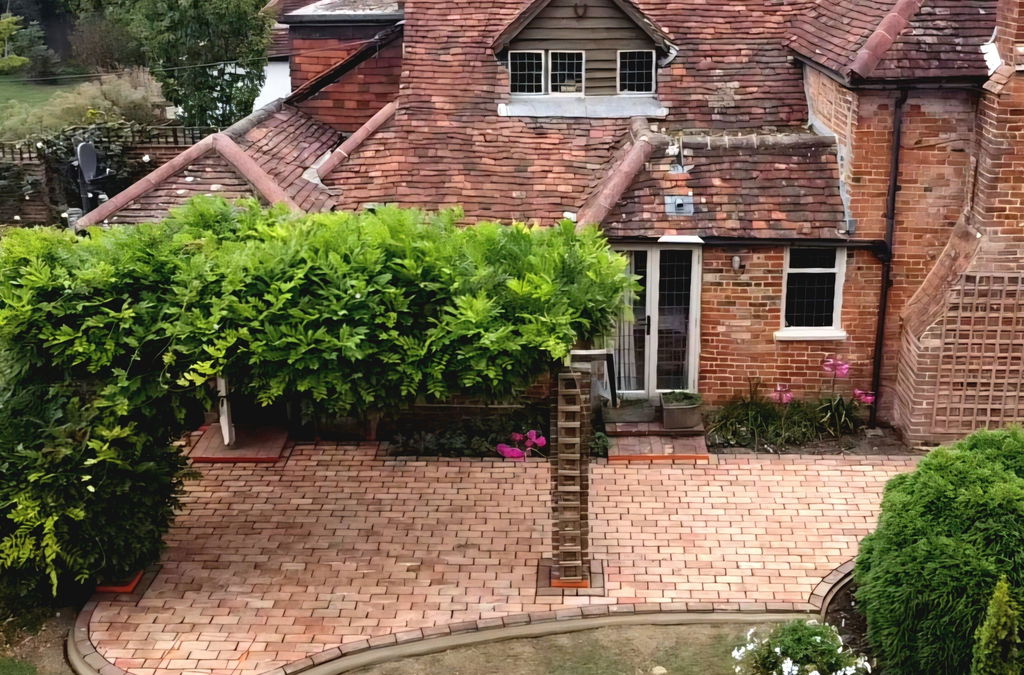
Brick has been one of Britain's most successful and enduring building materials for centuries. From Georgian townhouses and Victorian industrial buildings to humble agricultural structures, fired clay bricks have demonstrated remarkable longevity under a wide range of environmental conditions. Yet despite their widespread use, the physical properties that govern the performance and durability of traditional bricks are often poorly understood.
When specifying replacement materials for conservation and restoration projects, visual appearance is naturally important. However, matching the physical characteristics of the original brickwork is equally critical. A replacement brick that looks correct but behaves differently can lead to accelerated deterioration, moisture-related defects and long-term maintenance problems.
The performance of a traditional brick is influenced by several factors, including the composition of the clay, the manufacturing process, firing temperature and even the brick's position within the kiln. These variables affect properties such as compressive strength, porosity, water absorption, thermal conductivity and resistance to frost damage.
Clay Composition and Manufacture
The journey of a brick begins with its clay. Different regions of Britain contain clays with varying mineral compositions, giving rise to distinct colours, textures and physical properties. The proportion of silica, alumina, iron oxides, lime and other naturally occurring minerals all influence the finished product.
Historically, bricks were manufactured using local materials, resulting in significant regional variation. London stock bricks, Staffordshire blues, Cheshire reds and Yorkshire clamp bricks each possess unique characteristics reflecting their geological origins and manufacturing methods.
Traditional brickmaking methods also differed considerably from modern industrial production. Prior to the widespread adoption of tunnel kilns, many bricks were fired in clamp kilns or Hoffmann kilns. These systems often produced substantial variations in firing temperature throughout the kiln.
As a result, bricks from the same batch could exhibit markedly different properties. Underfired bricks were generally softer and more porous, while overfired bricks became denser, harder and occasionally vitrified. The most desirable bricks were typically those fired within an optimal temperature range, where sufficient strength and durability were achieved without excessive vitrification.
This variability explains why historic brickwork often displays subtle differences in colour, texture and performance that are rarely seen in modern machine-made products.

Figure 1: Clamp kilns produced significant variations in firing temperature. Under burnt bricks were generally softer and more porous, while overburnt bricks became denser and occasionally vitrified. This variability remains visible in many historic buildings.
Compressive Strength
Compressive strength is perhaps the most commonly quoted property of a brick. It measures the material's ability to withstand crushing forces and is typically expressed in Newtons per square millimetre (N/mm²).
Modern engineering bricks can achieve compressive strengths exceeding 75 N/mm², while contemporary facing bricks often fall within the range of 20–50 N/mm². Historic bricks, however, display a much wider range of values due to variations in raw materials and firing conditions.
Testing carried out on reclaimed bricks frequently reveals strengths that surprise modern specifiers. Bricks recovered from buildings constructed more than a century ago often demonstrate compressive strengths comparable to, and sometimes exceeding, many modern facing bricks.
It is important to remember that strength alone does not determine suitability. Many historic buildings have performed exceptionally well using relatively low-strength bricks because the material properties were appropriate for the construction methods employed. Lime mortars, for example, accommodate movement and moisture in a manner fundamentally different from modern cement-based systems.
For conservation projects, compatibility with existing masonry is usually more important than achieving the highest possible strength values.

Figure 2: Compressive strength testing of Reclaimed Bricks by Reclaimed Brick Company. Laboratory testing helps quantify structural performance and allows comparison between reclaimed and newly manufactured materials.
Porosity and Water Absorption
The pore structure within a brick has a profound influence on its long-term behaviour. Porosity refers to the volume of voids within the material, while water absorption measures the quantity of water that can be absorbed under specific test conditions.
A common misconception is that lower water absorption automatically indicates superior performance. In reality, the relationship is more complex.
Many traditional bricks possess relatively high porosity yet have survived for well over a century. Their success often stems from the nature of their pore structure rather than the total volume of pores present. Large, interconnected pores can allow moisture to enter and leave the brick relatively freely, reducing the likelihood of damaging internal pressures developing during freeze-thaw cycles.
Conversely, some denser materials with low overall absorption can be more vulnerable if moisture becomes trapped within fine pore networks.
Understanding moisture movement is particularly important when repairing historic buildings. Introducing dense replacement bricks into traditional permeable masonry can disrupt established moisture pathways and contribute to accelerated decay in adjacent materials.
Frost Resistance
Frost damage is one of the most significant causes of deterioration in masonry exposed to the British climate.
The mechanism is relatively straightforward. Water enters the pore structure of a brick and expands by approximately nine per cent when it freezes. If the brick cannot accommodate this expansion, internal stresses develop, leading to cracking, spalling and eventual disintegration.
However, frost resistance is not determined solely by water absorption. The size, distribution and connectivity of pores play an equally important role.
Many traditional bricks that would not satisfy modern frost-resistance classifications have nevertheless survived repeated freeze-thaw cycles over many decades. Their continued existence provides valuable evidence of performance under real-world conditions.
Indeed, one of the most compelling arguments in favour of reclaimed bricks is that they have already demonstrated their durability. A brick that has successfully endured 100 or 150 years of exposure has effectively undergone a long-term field test that no laboratory programme can fully replicate.
This does not eliminate the need for testing, but it does provide valuable insight into likely future performance.
Salt Crystallisation and Durability
In addition to frost action, masonry can suffer deterioration from salt crystallisation. Soluble salts are transported into brickwork by moisture and can originate from the ground, marine environments, de-icing treatments, atmospheric pollution or adjacent construction materials.
As water evaporates, dissolved salts crystallise within the pore structure. The growth of salt crystals generates pressure that can exceed the tensile strength of the brick, leading to surface scaling, flaking and gradual material loss.
Traditional bricks vary considerably in their resistance to salt attack. Again, pore structure is often more important than simple density or strength.
Historic masonry systems typically managed moisture movement through breathable construction methods, including lime mortars and permeable finishes. Where these systems remain intact, salt-related deterioration is often limited. Problems frequently arise when impermeable materials are introduced during repairs, preventing normal evaporation and concentrating moisture within the masonry.
For conservation professionals, understanding the relationship between moisture, salts and brick performance is essential when specifying repair strategies.

Figure 3: Historic brick masonry that has survived for more than a century provides valuable evidence of long-term durability. The continued performance of traditional fired clay bricks demonstrates the resilience of well-manufactured masonry under real environmental conditions.
Thermal Properties
As energy efficiency becomes an increasingly important consideration in building design and refurbishment, the thermal properties of traditional masonry have attracted renewed interest.
Brick possesses a relatively high thermal mass, meaning it can absorb, store and gradually release heat. This characteristic helps moderate internal temperature fluctuations and contributes to occupant comfort.
Thermal conductivity, which measures the rate at which heat passes through a material, varies according to density, porosity and moisture content. Generally speaking, denser bricks exhibit higher thermal conductivity than lighter, more porous materials.
While traditional solid brick walls may not achieve the insulation values expected of modern cavity wall construction, they often perform better in practice than theoretical calculations suggest due to their thermal mass and moisture-buffering capabilities.
When assessing historic buildings, it is therefore important to consider whole-building performance rather than focusing solely on individual material properties.
Embodied Energy and Environmental Performance
The environmental impact of construction materials is becoming increasingly important for architects, developers and building owners.
The manufacture of new clay bricks requires the extraction of raw materials followed by firing at temperatures that typically exceed 1,000°C. This process consumes significant quantities of energy and contributes to greenhouse gas emissions.
Reclaimed bricks offer a fundamentally different environmental profile. The original firing energy was expended decades or even centuries ago. By recovering, cleaning and reusing existing bricks, the environmental burden associated with manufacturing new products is largely avoided.
Recent Environmental Product Declaration (EPD) data has demonstrated that reclaimed bricks can achieve exceptionally low embodied carbon values compared with newly manufactured alternatives. This places them among the lowest-carbon structural building materials currently available.
For conservation projects, the environmental benefits align naturally with the broader principles of heritage preservation. Retaining and reusing existing materials conserves embodied energy, reduces waste and supports a circular economy approach to construction.
Conclusion
The physical properties of traditionally fired clay bricks are the product of a complex interaction between geology, manufacturing methods and firing conditions. Variations in clay composition, kiln technology and firing temperature produce materials with a wide range of strengths, porosities and durability characteristics.
For conservation professionals, understanding these properties is essential when specifying repairs and replacement materials. While visual matching remains important, compatibility in terms of moisture movement, thermal behaviour and long-term durability is often equally significant.
Perhaps the most remarkable characteristic of traditional brick is its proven longevity. Across Britain, countless buildings continue to perform successfully after more than a century of service. Their continued survival provides compelling evidence of the durability and resilience of fired clay masonry.
As conservation practice increasingly embraces sustainability alongside heritage protection, reclaimed bricks offer a unique combination of historic authenticity, proven performance and exceptionally low embodied carbon. Understanding their physical properties enables specifiers to make informed decisions that respect both the past and the future of the built environment.
(RBC-B-160)